
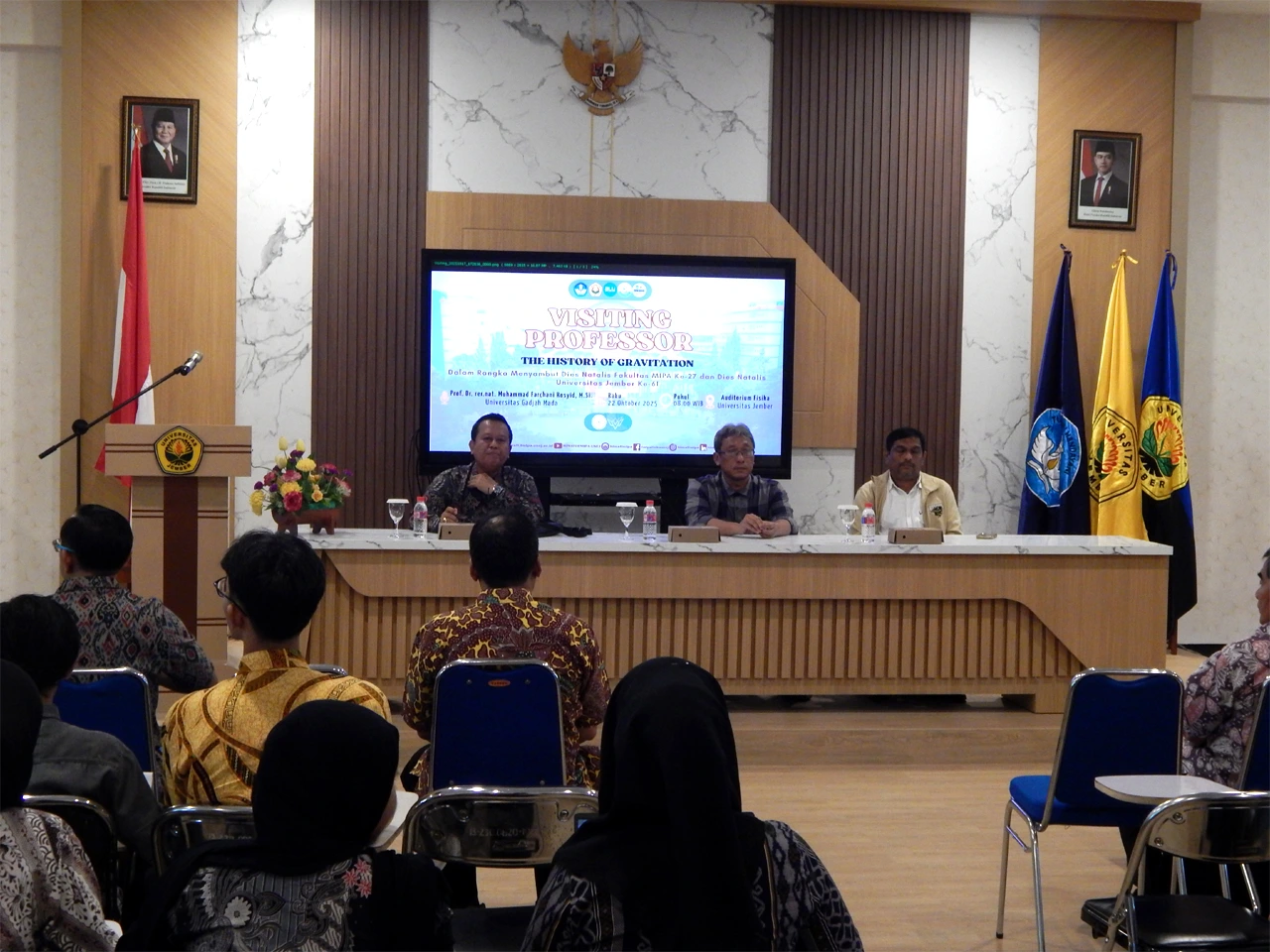
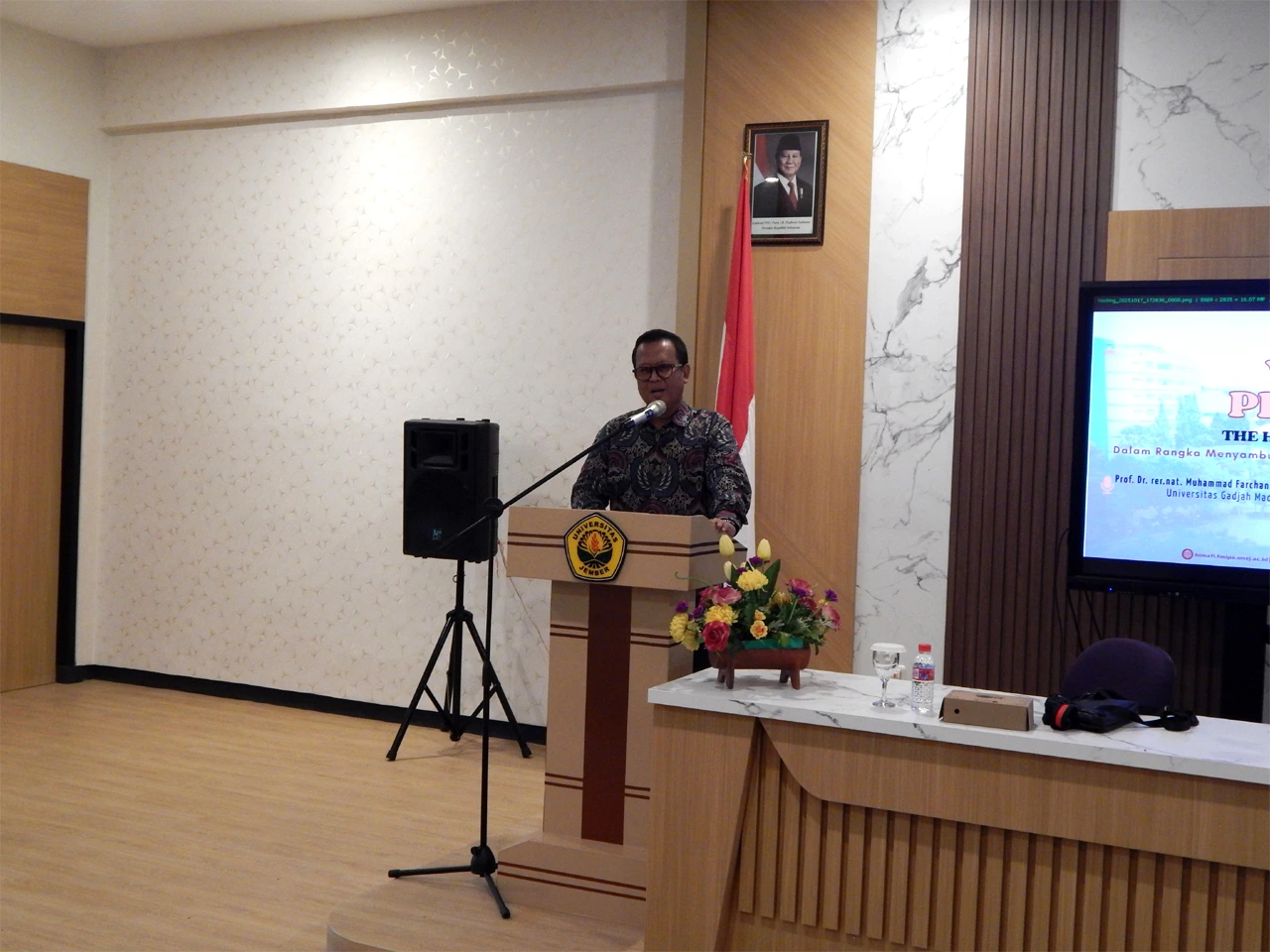
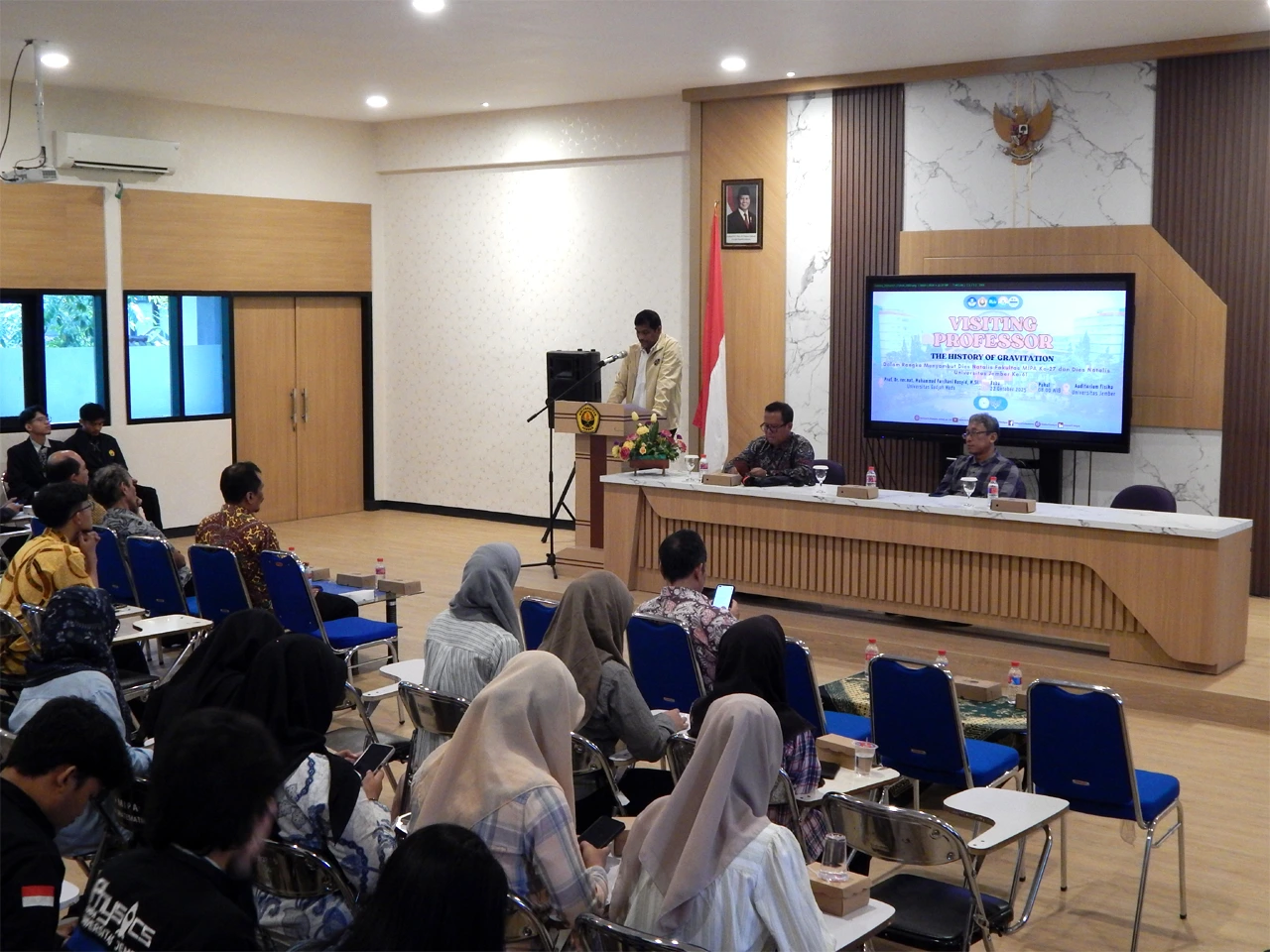
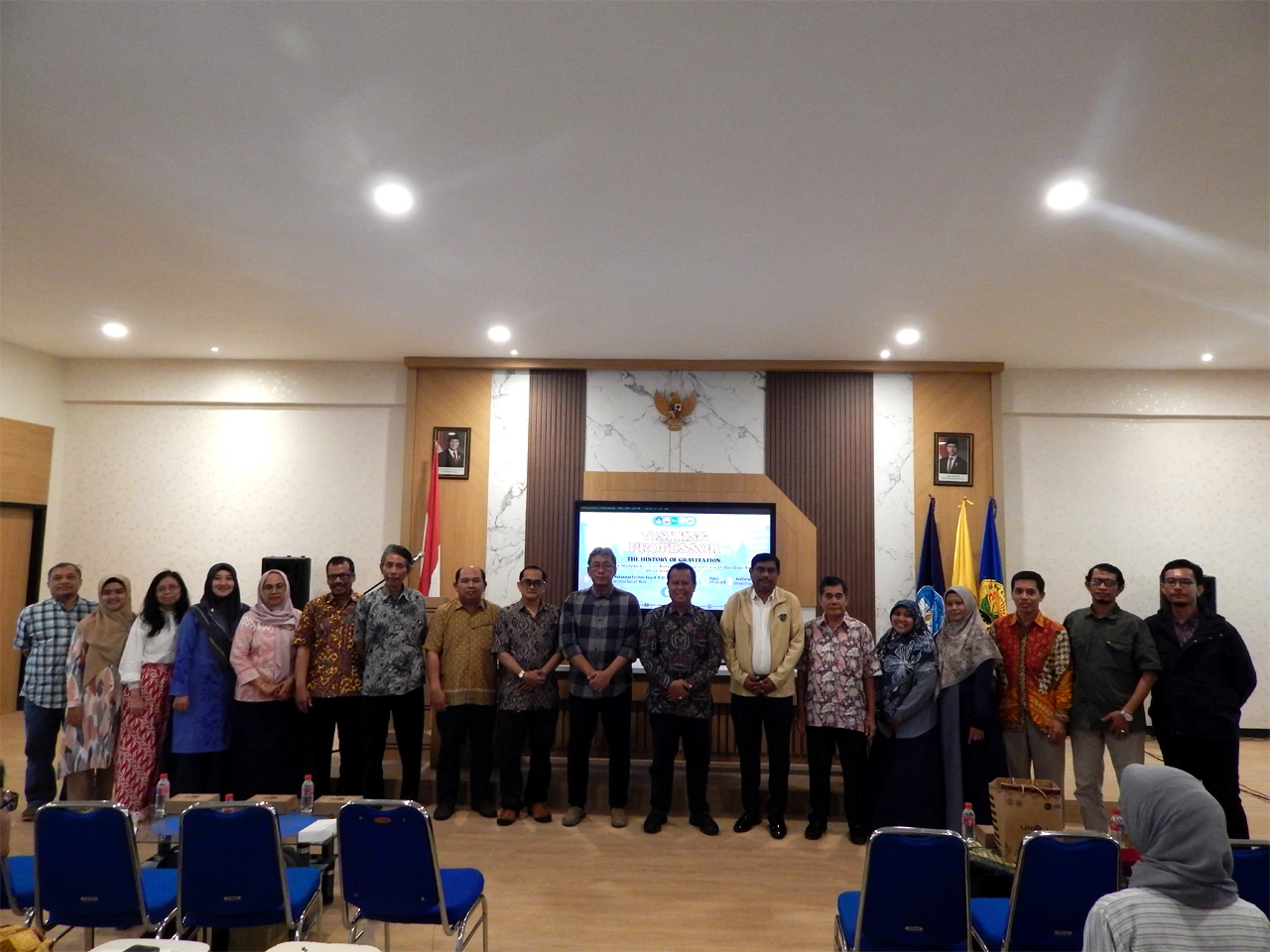
 In a series of 27th birthday parties of the Faculty of Science and 61st birthday parties of the University of Jember. The Department of Physics FMIPA organized a visitor professor presenting Prof. Dr. rer.nat. Muhammad Farchani Rosyid, M.Si. from the Department of Physics, FMIPA, UGM (22/10). Taking up the topic of “THE HISTORY OF GRAVITATION”, the event was formally opened by the Dean of FMIPA UNEJ Prof. Drs. Dafik, M.Sc., Ph.D. In his welcome the Dean said today’s event was special because it brought a professor from UGM who would deliver a lecture on the history of gravity. “It will discuss the development of the concept of gravity, starting from Aristotle who believed objects fall because they return to their natural place, to Galileo who proved all objects fall in the same way without hindrance,” he said in FMIPA’s Physics Auditorium.
Prof. Dafik said Einstein developed a theory of general relativity that explained gravity as the curvature of space-time by mass, as well as predicting phenomena such as gravitational waves. “And that the concept of balance in the universe has been mentioned in the Qur’an, Surah Al-Mulk verses 3-4, which shows the relationship between science and religious belief,” he continued. The Dean also invited as well as Prof. Veerabhadriah Lokesha from India and Prof. Sudrajat Supian, M.Sc., Ph.D. from the University of Padjajaran. Earlier, the welcoming speech was also delivered by the Chairman of the Department of Physics FMIPA Dr. Agus Suprianto, S.Si., M.T. who is also a fellow speaker during his doctoral studies at UGM Yogyakarta.
Prof. Veerabhadriah Lokesha had the opportunity to deliver a speech before the presentation of the material. “As someone who has had an interest in physics since college, I was excited to attend this event because the connection between physics and mathematics is so close,” he begins. Professor of Analysis and Discrete Mathematics
from Vijayanagara Sri Krishnadevaraya University, India it says Physics and mathematics are closely related in explaining the universe, from the concepts of acceleration, velocity, to motion. “Since ancient times, humans have observed the movements of stars and planets. Yet it was only in the 16th century that the scientist Galileo began to prove the concept of gravity through experiments and mathematics,” he concluded.
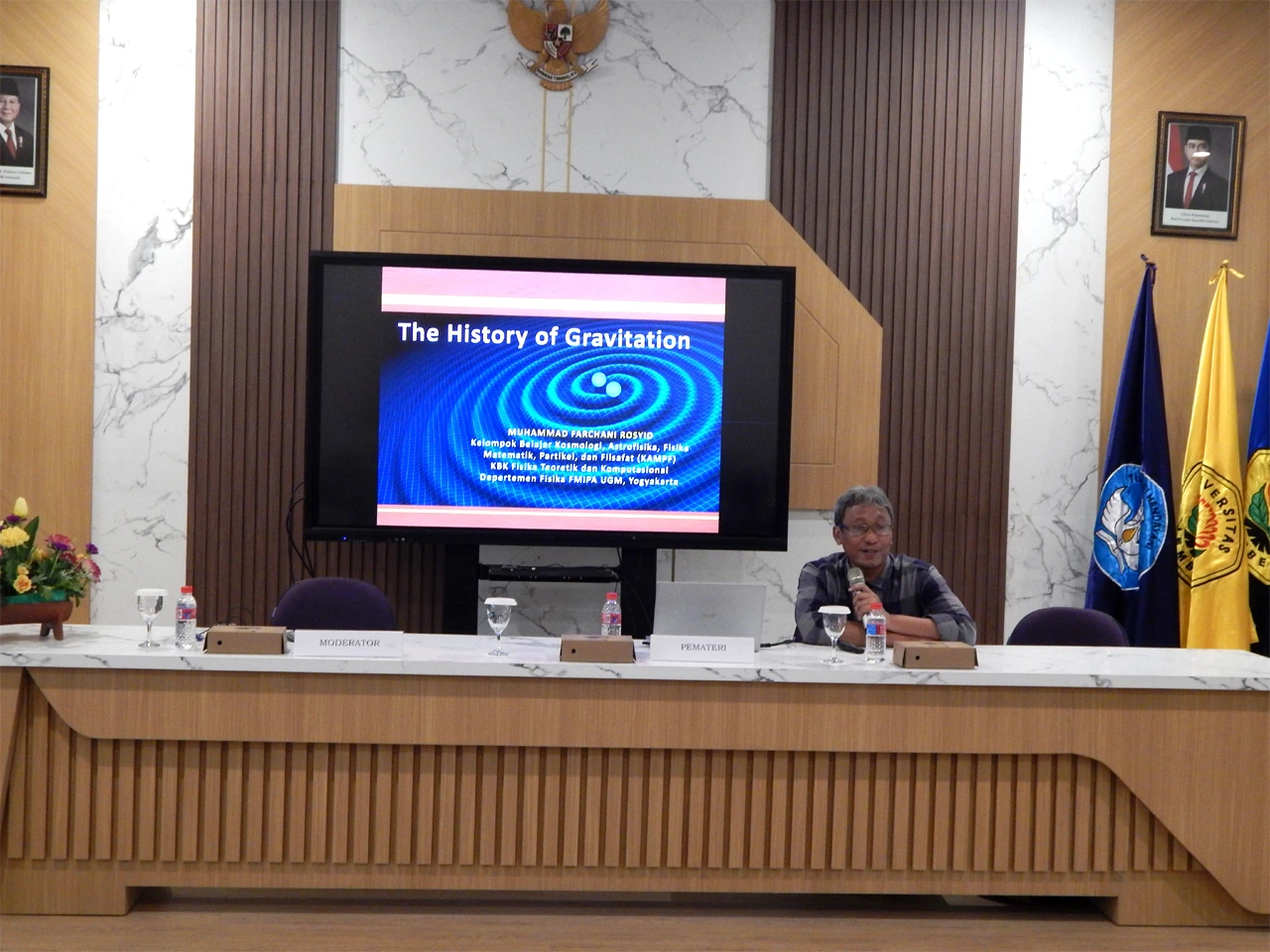
Prof. Dr. rer.nat. Muhammad Farchani Rosyid, M.Si. prefaces the material on how important and extensive the role of gravity is in the life of the universe. He shares his decades of experience in the field and emphasizes that gravity is not always readily apparent. “The impact of gravity is very real from objects falling to the ground, tree roots growing downwards, the phenomenon of tides of seawater, to the formation of stars and suns as a result of the collapse of molecular clouds,” he explains. Gravity also affects geological structures on Earth and even on other planets such as Mars and the Moon.
Gravity is also explained as the cause of various phenomena such as the tides of ocean water, the formation of planetary rings, the breakup of comets by tidal forces (tidal force), and the movement of celestial bodies. However, there were phenomena that could not be explained by Newtonian gravity, such as the precession of Mercury’s orbit, the bending of light, and the redshift of gravity, which were later explained by Einstein’s theory of general relativity. “Gravity is a fundamental phenomenon that is not only useful in underground exploration, but is also key in understanding the structure of the universe,” he continued.
In modern physics, gravity is understood not as a conventional force, but rather as a curvature of spacetime due to mass and energy, according to Einstein’s theory of general relativity. Although the other three fundamental forces have been unified in field theory, gravity is still difficult to combine due to differences in theoretical paradigms. “Various efforts, such as teleparallel gravity, attempt to bridge this gap, yet still face mathematical challenges. While some scientists are trying to develop new approaches, the majority of the scientific community still maintains a view of gravity as a space-time geometry,” he concludes. The event closed with an answer session with visiting professor participants.
 |
 |
 |
 |